- 2011
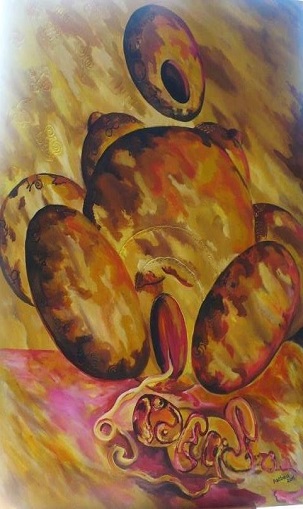
Birth, (Abstract painting, Acrylic on canvas)
‘Birth’ makes a call to patriarchal communities, saying that; women are not only capable of giving birth but are also very capable of conceiving significant ideas that are needed for the development of a society. Asabea rightly notes that God in his own unique way created the woman to be able to contain that which two people have decided to have for nine months, and then gives birth to it; the woman should therefore never be suppressed; if her child is accepted then she must be also allowed to express her ideas at all levels of life.
If the ideas of a woman are not considered, society will be missing out on a lot of creative ideas. During the period of pregnancy, the emotions, thoughts and daily intake of the woman affects the unborn child just as the way a woman is treated in society has an untold effect on society. Upon a critical observation of the “birth”, you will notice that a woman has giving birth to a baby that assumes a form of the word ‘ideas’.
Asabea saw the challenges of the woman from the heat that the cooking pot receives while cooking. She assembled the pots to depict a woman giving birth. In most African cultures, there is a lot of antagonistic ideas towards women. Several feminists study prove this. Asabea’s experience in life as a woman has a lot to add up to this antagonistic nature of societal and cultural ascendence’s towards women. “Birth” shows the struggle and pain one goes through before giving birth physically and conceptually.
Familusi (2012) affirms the above analysis also. To arrive at a tangible result in dismantling gender biases, sensitization and education must continue to raise women’s consciousness about their emancipation, where both men and women must be involved, since society cannot move forward without both genders collaboratively.
Back To Home